Smart Flexible Pressure Sensing Solutions

Every touch, precisely understood

JingSense smart flexible pressure sensing is built around an array-based piezoresistive film — thin, bendable and able to conform to curved surfaces and the human body. High-precision sampling circuitry and algorithms deliver multi-point smart pressure sensing with high sensitivity, low latency and low noise, while an optional flexible heating layer brings sensing and heating onto a single substrate. Because the array continuously tracks how pressure distribution changes over time, the platform also extends toward heart rate and respiration sensing for wearables, smart bedding and health-care scenarios. The compact, high-speed module supports multiple communication protocols and integrates easily into diverse systems.

Three Core Capabilities

Smart pressure sensing, flexible heating, and heart rate & respiration sensing — the three application directions of the JingSense smart flexible pressure sensing platform.

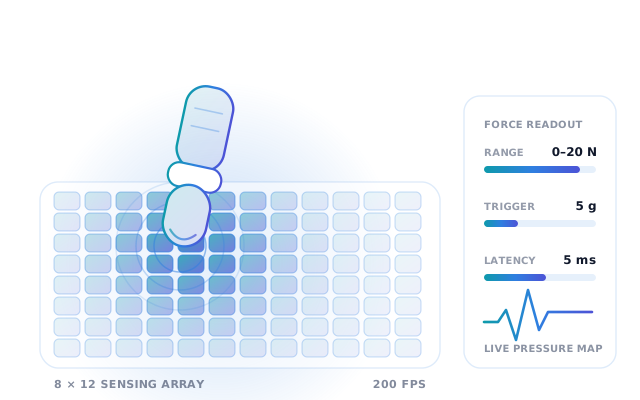
Smart pressure sensing application illustration: a robotic dexterous hand fingertip pressing a flexible pressure sensing array that outputs a live pressure map
01

Smart Pressure Sensing

A high-density piezoresistive array outputs a live pressure-distribution map, with trigger force as low as 5g, a 0–20N range and a 200 FPS frame rate — capturing the force, location and trend of every touch. This is the foundation for robotic dexterous-hand tactile sensing and precise force feedback.

  • Robotic dexterous-hand tactile sensing
  • Real-time grip force feedback
  • Live pressure distribution map
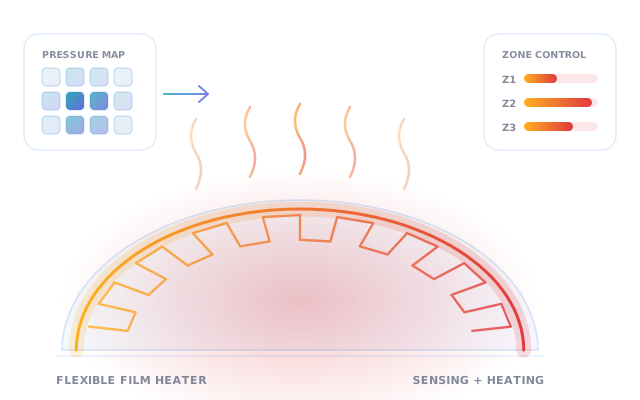
Flexible heating application illustration: a flexible film heater conforming to a curved surface with temperature controlled by pressure-sensing feedback
02

Flexible Heating

Heating traces are integrated onto the same flexible substrate, warming curved surfaces evenly while pressure signals feed back to control which zones are heated and how strongly — integrated sensing-and-heating for heated bedding, seating and wearable wellness products.

  • Integrated sensing and heating
  • Even warming on curved surfaces
  • Zone control driven by pressure map
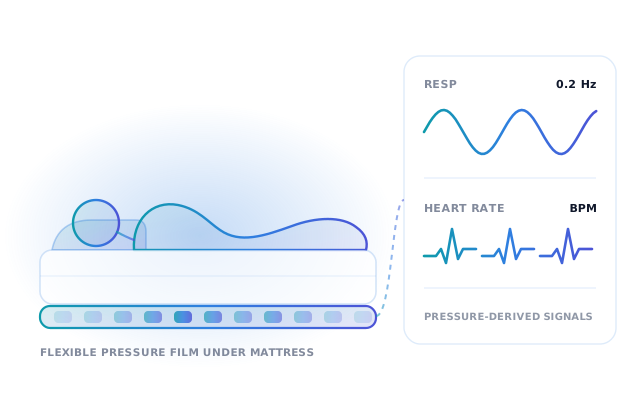
Heart rate and respiration sensing application illustration: a flexible pressure sensing film under a mattress capturing breathing and heartbeat waveforms
03

Heart Rate & Respiration Sensing

Placed under a mattress, cushion or worn band, the film continuously captures the small periodic fluctuations in how body weight is distributed over time. JingSense is developing this into heart rate and respiration sensing — deriving breathing rhythm and heart rate variation from the pressure signal for unobtrusive, contact-free physiological monitoring.

  • Smart bedding and sleep monitoring
  • Contact-free measurement
  • Application direction in development

Applications

Robotic Dexterous HandsGives robotic hands tactile perception for more precise grasping and manipulation.
Smart Pressure Tactile SensingHigh-precision array-based smart pressure sensing captures fine touch variations for precise tactile feedback.
Flexible Heating ApplicationsCombined with flexible film heating technology for integrated sensing-and-heating applications.
Heart Rate & Respiration SensingSmall periodic changes in pressure distribution extend toward heart rate, respiration and other physiological monitoring.
Wearable DevicesThin, flexible modules integrate easily into wearables for pressure-based interaction.

Key Features

Multi-Point Smart Pressure ArrayPiezoresistive array design fully captures pressure distribution and change trends.
High-Speed Stable CommsUSART interface supporting up to 2 Mbps with a 200 FPS frame rate.
Wide Measuring Range0–20N range with trigger force as low as 5g, covering light touch to heavy pressure.
Durable & ReliableRated for 100,000+ cycles under standard load, operating from 0–70°C.

From requirements to mass production

STEP 01

Requirement Discovery

Understand the customer's product positioning and use cases to propose an initial solution.

STEP 02

Solution Design

Integrated optical, electronic, structural and firmware design based on the required specifications.

STEP 03

Sample Validation

Engineering samples are validated for function and reliability, with specs refined iteratively.

STEP 04

Mass Production

Hand-off to production lines and quality control to ensure stable output and delivery.